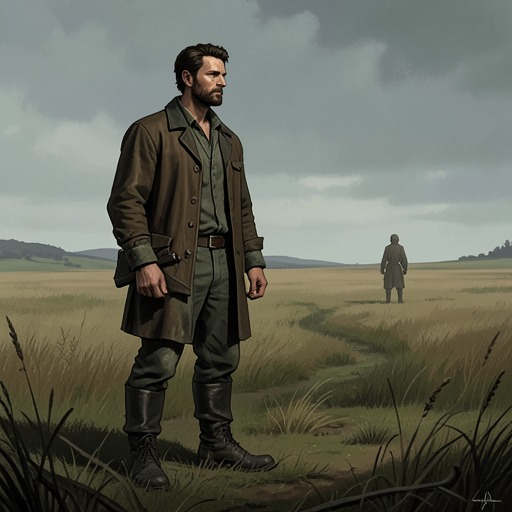
Tito lascia Nina nella botola e la fattoria viene incendiata
Senza sangueTito leaves Nina concealed in the floor hatch of the farmhouse at Mato Rujo as he escapes with Salinas and el Gurre; the house is then consumed by fire. The episode turns a hidden child’s chance of survival into a decision Tito cannot bring himself to voice, and its aftermath follows him in the form of a question he keeps repeating: what have they done?
Discovery in the Hidden Room
While searching the farmhouse, Tito hears el Gurre methodically striking the walls with a machine gun, looking for concealed doors. In a small room crowded with overturned chairs, trunks, tools, and baskets of half-rotten fruit, he notices dust disturbed as if someone—or something—had dragged its feet across the floor. Moving the baskets reveals a carefully cut hatch.
Tito opens it and finds Nina curled on her side, her hands tucked between her thighs and her head bent toward her knees. She is awake. He points his pistol at her and calls for Salinas, but no one answers. Nina looks at him without expression and breathes calmly, still folded into the posture of a creature sheltering in its den. The narration links her position to a bodily memory Tito recognizes from childhood: the curled posture feels familiar, even beautiful to him, and for a moment he regards it as complete and orderly.
The Choice to Leave
Nina turns her head back into the same closed posture. Beyond the curtain, the search continues; outside, night has fallen. Tito lowers the hatch lid slowly and remains kneeling, watching the floorboards as if he might see her through their cracks. He cannot think clearly. His heart pounds at his temples, but he replaces the baskets and leaves without bringing Nina out.
As the group moves away from the farmhouse, Tito has already decided what he wants to say: there is still a girl inside. The silence of the fields and his exhaustion keep the sentence unspoken. The narrative makes the omission concrete: Nina is not forgotten or undiscovered, but found and knowingly left behind. Tito’s hesitation is the hinge between the possibility of taking her with them and her abandonment in the hiding place.
Fire and Confrontation
Salinas is trembling and struggling to walk, supported and pushed forward by el Gurre. After they have gone some distance, Salinas sends el Gurre back toward the farmhouse. Tito and Salinas continue past a woodpile and take a field path toward the old Mercedes. When el Gurre runs back, the farmhouse is already split by firelight, flames breaking out across it as black smoke rises into the night.
Tito stops, then seizes el Gurre by the neck and demands to know what he has done. El Gurre urges him to calm down and keep moving; Salinas also shouts at him to stop. The scene becomes a struggle among the three men, and they finally drag Tito away by force. The fire has turned the farmhouse into the image that governs the episode: a home and hiding place being erased while the child inside it remains unaccounted for.
Escape and Aftermath
The men cross a field and follow the trace of an old riverbed down to the road. Near the Mercedes, el Gurre puts a hand on Tito’s shoulder and tells him quietly that he had done well and that everything is over. Tito does not answer with relief. He repeats, softly and in a childlike voice, “What the hell have we done.” The phrase persists as they leave, turning his earlier silence into an acknowledgment of shared responsibility, though it does not undo his choice or rescue Nina.
The farmhouse stands out in the dark countryside, red with flame against the emptied plain. Three days later, a rider reaches its remains: blackened walls stand among the cooled ashes, and the fire has also destroyed the great oak that had shaded the house for years. Nina’s discovery and Tito’s decision thus lead into an aftermath marked by destruction rather than confirmation of her fate. Later, the account of the plot against Nina establishes that the men believed she might know something about Salinas’s death and decided she should be eliminated; it also identifies her as a danger in their eyes. The fire at Mato Rujo is therefore not merely the destruction of the building: it belongs to a chain of concealment and attempted silencing whose consequences continue after the raid.
The Meaning of the Repeated Question
The episode’s force lies in the gap between seeing and acting. Tito finds Nina with his own eyes, even aims his pistol at her, and then closes the hatch without speaking. When the fire makes the consequences visible, he can no longer keep his response inside: he confronts el Gurre, is physically carried away, and repeats the question that gives the episode its enduring moral shape.
That question does not function as a solution or absolution. Tito’s companions insist that it is over and that he has done well, but his childlike repetition refuses their closure. The sequence holds together an individual failure to act, the group’s escape, and the destruction of the place where Nina remains hidden. Its central reversal is stark: a search that uncovers a living child ends with the men abandoning her to a burning farmhouse, while the one man who recognizes what has happened can only name it after there is no time left to change it.